THE STARTING POINT
What this audience needed.
Help scientific and mission leaders examine how the environment around space innovation was changing.
WHAT MADE IT SPECIFIC
The audience shaped the research.
The assignment included a keynote and half-day working session with mission directors, scientists, researchers and innovation leaders. It required a conversation about the ecosystem surrounding advanced science, alongside the organization’s technical capabilities.
- Scientific collaboration
- Innovation ecosystems
- Changing partnerships
- Leadership and organizational agility
HOW THE KEYNOTE CONNECTED THE ISSUES
What made the content specific.
Respect the scientific depth of the audience
Mission directors, scientists, researchers and innovation leaders already had substantial technical expertise. The assignment required a perspective on the environment surrounding their work: the business of space, collaboration and the changing conditions for innovation.
Explore the innovation ecosystem
The keynote and working session considered how advanced scientific organizations connect with wider networks of knowledge and opportunity. That made partnerships, organizational agility and the ability to work across boundaries relevant parts of the conversation.
Use the format for deeper exploration
A keynote combined with a half-day working session creates a different experience from a stand-alone conference speech. It allows the future perspective to become a starting point for discussion among people responsible for complex missions and research programs.
FROM THE PUBLISHED CASE STUDY
Inside the engagement.
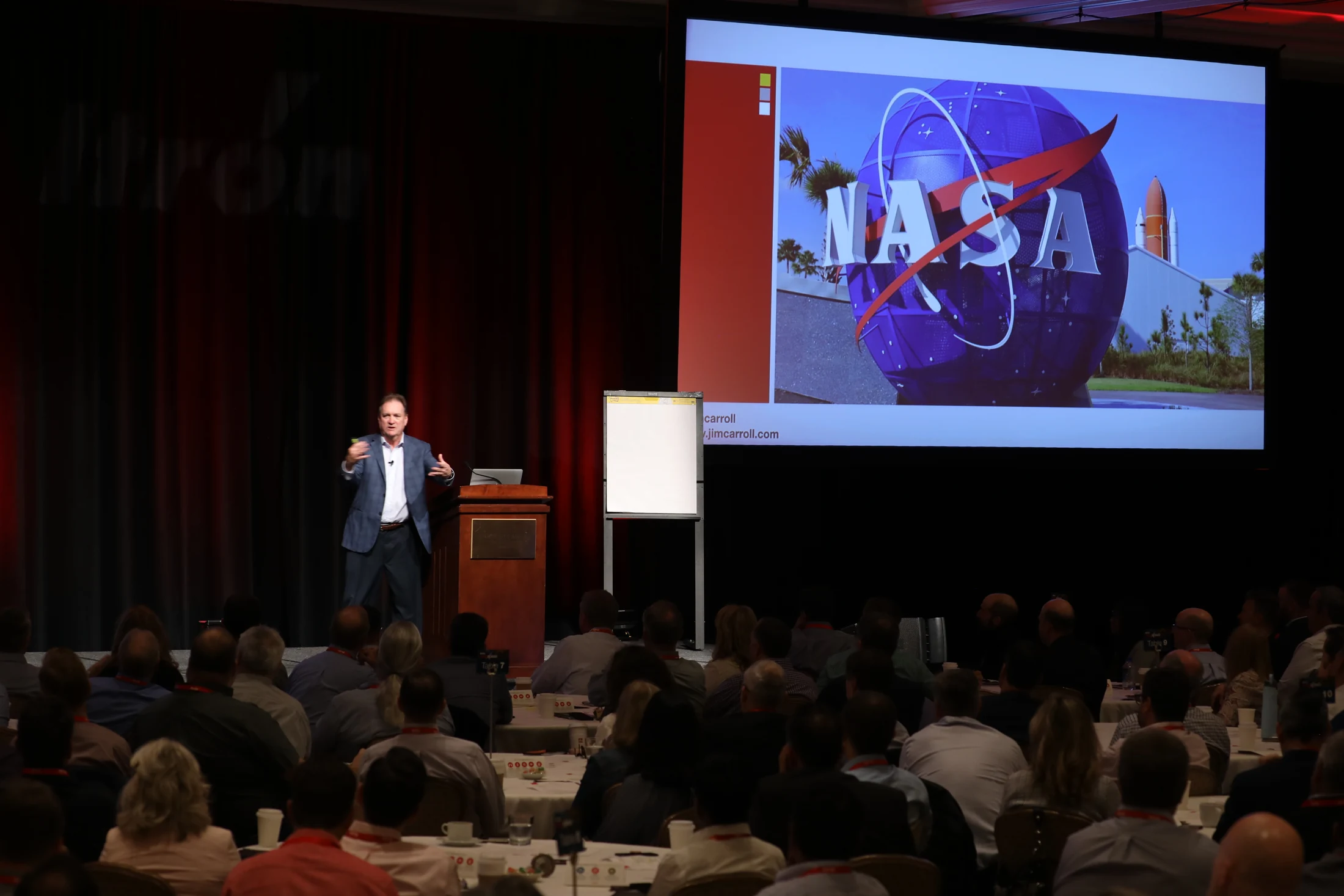
And yet that was precisely the challenge I was asked to address when I spent a day at NASA’s Goddard Space Flight Center with senior mission directors, scientists, researchers and innovation leaders.
The keynote and half-day working session were hosted by Goddard’s Innovative Technology Partnerships Office. The audience included people responsible for some of the most complex scientific and engineering programs on the planet — including members of the team working on the James Webb Space Telescope.
The business of space was no longer defined only by government agencies and traditional aerospace organizations.
Privately funded ventures were accelerating. Commercial launch systems were developing. New entrepreneurs were entering the sector. Crowdfunding was beginning to finance scientific ideas. New business models were appearing around space tourism, in-space manufacturing, pharmaceuticals and asteroid mining.
For a research-driven organization such as NASA, the acceleration of external innovation meant that partnership, collaboration and openness would become increasingly important.
The old model assumed that breakthrough science happened inside large institutions with large budgets and long planning cycles.
Source: Read Jim’s original case study ↗. This profile describes the keynote’s content and approach; it does not claim business results beyond those documented in the source.
BUILD ON THE INDUSTRY CONTEXT
Governing at the speed of change.
Public-sector innovation must connect changing expectations with responsibility. The focus is institutional capability, public trust and practical choices in a faster world.